Mansa Musa – A Biography
Mansa Mūsā (reigned c. 1312–c. 1337) was the most famous ruler of the Mali Empire, celebrated for his extraordinary wealth, his 1324 pilgrimage to Mecca that announced Mali to the wider world, and his patronage that helped make Timbuktu a major center of Islamic learning.
Beginnings and early life
Mansa Mūsā (Musa I) was born into the Keita dynasty, the ruling family of the Mali Empire founded by Sundiata Keita in the 13th century. By the time Musa ascended the throne around 1312 CE, Mali was already a formidable power, controlling trade routes that linked West Africa to North Africa and the Mediterranean.
Musa reportedly came to power after his predecessor, Abu Bakr II, embarked on a voyage across the Atlantic and never returned. His accession highlights Mali’s stability: succession was orderly, and Musa inherited a state with strong institutions, abundant resources, and a reputation for wealth. The empire’s prosperity rested on gold mines in Bambuk and Bure, and the taxation of caravans carrying salt, ivory, and slaves across the Sahara.
Patronage and Cultural Flourishing
Musa’s reign is remembered for his lavish patronage of religion, architecture, and scholarship. After his famous pilgrimage, he returned with architects and scholars, including the Andalusian architect Abu Ishaq al‑Sahili, who is credited with designing mosques in Timbuktu and Gao.
He funded the construction of the Djinguereber Mosque and expanded the Sankoré University, turning Timbuktu into a beacon of Islamic learning. Musa’s patronage wasn’t limited to buildings: he endowed scholars, imported books, and encouraged manuscript production, creating a scholarly tradition that lasted centuries. His efforts linked Mali more firmly to the Islamic world, embedding it in networks of faith, trade, and intellectual exchange.
Wealth and Global Reputation
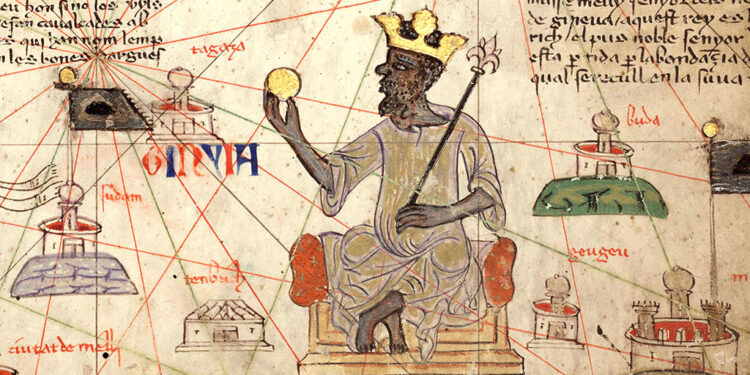
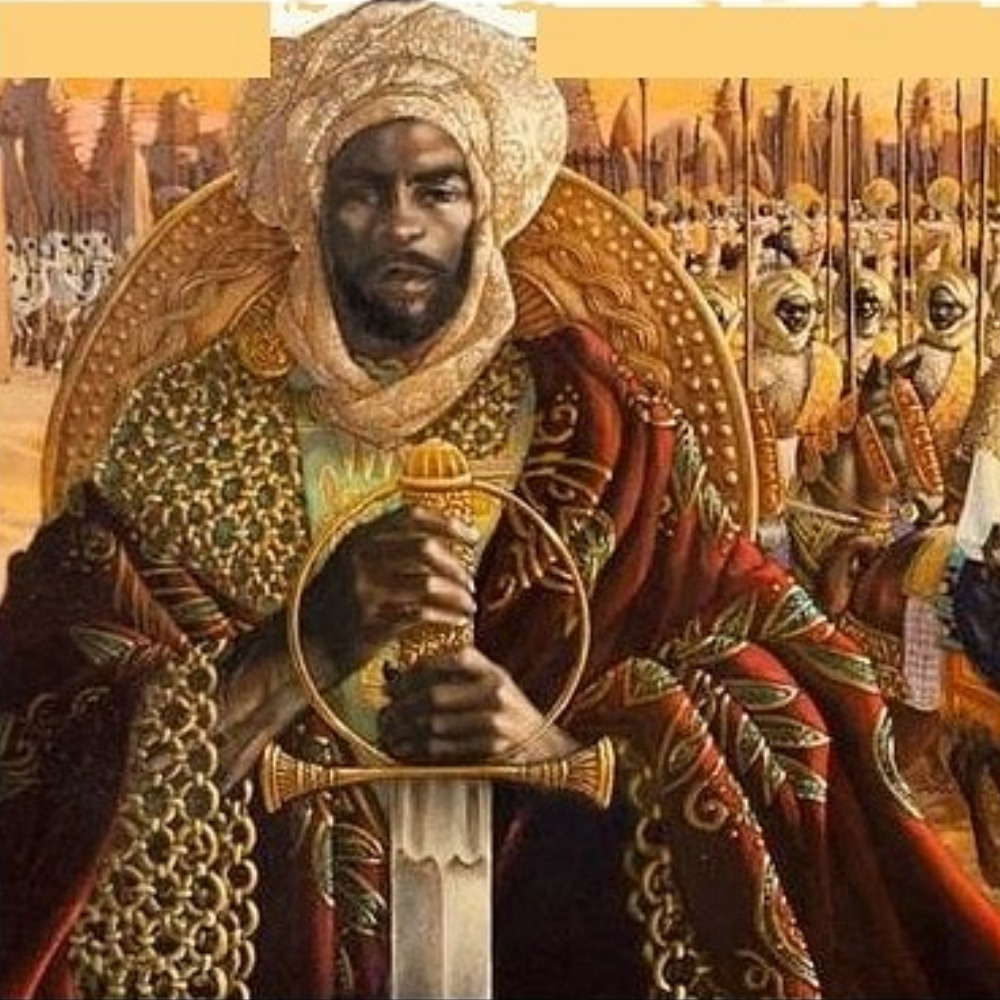
Mansa Musa
Mansa Musa of Mali Empire Img credit: qiraatafrican.com
Mansa Mūsā’s wealth was legendary, and contemporary accounts often describe him as the richest man in history. His 1324 hajj to Mecca became the defining episode of his reign. Traveling with tens of thousands of attendants and camels carrying gold, Musa distributed so much wealth in Cairo that the value of gold reportedly fell for over a decade.
Chroniclers such as al Umari marveled at his generosity and piety, noting how his gifts reshaped economies along his route. In Europe, his fame spread through cartography: the 1375 Catalan Atlas depicts him holding a golden nugget, symbolizing Mali’s riches. While exact figures are impossible to verify, Musa’s wealth derived from Mali’s control of gold mines and trade taxation, making his empire one of the most prosperous of its time.
Death and Legacy
Mansa Mūsā is believed to have died around 1337 CE, though some sources suggest slightly later dates. His death marked the end of Mali’s golden age; while successors inherited a vast empire, they struggled to maintain the same level of centralized authority. Over time, Mali’s dominance waned as rival powers like the Songhai Empire rose.
Musa’s legacy, however, endured: Timbuktu remained a center of learning, and his pilgrimage continued to be cited as proof of Africa’s wealth and sophistication. Modern historians view him as a ruler who not only embodied immense material wealth but also invested in cultural and intellectual capital, leaving a legacy that shaped perceptions of Africa for centuries.
References
- Levtzion, Nehemia, and J. F. P. Hopkins (eds.). Corpus of Early Arabic Sources for West African History. Cambridge University Press, 1981.
- Hunwick, John O. Timbuktu and the Songhay Empire: Al-Saʿdī’s Taʾrīkh al-Sūdān down to 1613 and other contemporary documents. Brill, 1999.
- Conrad, David C. Empires of Medieval West Africa: Ghana, Mali, and Songhay. Facts on File, 2005.
- “Catalan Atlas, 1375.” Bibliothèque nationale de France.
- Al‑Umari’s account of Mansa Musa’s hajj, summarized in Levtzion & Hopkins (1981).


latest video



nia via inbox
Stay connected. Subscribe and get updated on what's new with Nia!