King Ezana of Aksum: A Biography
King Ezana ruled Aksum in the early to mid fourth century CE, usually dated about 330–356 CE. He is best known for adopting Christianity for the kingdom, for the Ezana Stone that records his campaigns, and for helping Aksum grow into a stronger regional power.
Beginnings and early life
Ezana became king while still young. His mother, Sofya, acted as regent and stayed influential at court. Frumentius, a Christian cleric who worked in the Red Sea world, was Ezana’s tutor and spiritual guide. Later church accounts say Frumentius converted Ezana and helped set up the early Ethiopian church. Those relationships shaped Ezana’s beliefs and how he used religion in government.
Political and economic context
By Ezana’s time, Aksum was a major player in Red Sea trade. Control of ports and trade in ivory, gold, frankincense, and textiles created the wealth that supported a centralized state. The kingdom minted coins, raised stelae, and kept ties with South Arabia and the Roman Mediterranean. Ezana inherited a state with money and logistics to act beyond its immediate region.
Reign and main accomplishments

King Ezana of Aksum
King Ezana of Aksum, after converting to Christianity, Source: Austria-Forum (https://www.thecollector.com/aksum-ethiopian-christianity/)
Religious change
Ezana’s conversion to Christianity is the most visible change of his reign. He put Christian symbols on coins and mentioned the faith in inscriptions. That public move helped make Christianity part of Aksum’s official identity and linked the kingdom to other Christian states.
Economic and administrative steps
Ezana kept and expanded Aksum’s minting and public inscriptions. Coins from his reign show Aksum’s role in regional trade. The stelae and inscriptions are part of a program of royal messaging and record keeping that strengthened central control.
Diplomacy and international ties
Under Ezana, Aksum kept and deepened ties with South Arabia and the Roman world. Its position on Red Sea trade routes let it influence commerce between interior Africa and Eurasia. Ezana’s coins and inscriptions advertise that reach.
Military campaigns and the Ezana Stone
The Ezana Stone is the main contemporary source for Ezana’s military actions. It is a trilingual stele in Geʽez, Sabaean, and Greek set up at Aksum. The inscription names campaigns against peoples often called the Noba and the Kasu. The Greek text gives specific numbers for captives, livestock, and provisions, and it describes moving and provisioning captured chiefs and their followers.
When read with archaeological and environmental evidence, the inscription suggests these were not just quick raids. The text mentions river junctions and the erection of a throne at a confluence, which many scholars read as signs of strategic operations in the Nile corridor. Many historians link these campaigns to the wider decline of Meroë in the mid fourth century, seeing Aksumite action under Ezana as a major factor that sped up the collapse of centralized Meroitic rule.
What the inscription shows about state capacity
The numbers in the inscription imply Aksum could provision and resettle large groups of captives. That points to real administrative ability, not just opportunistic raiding. The mix of military action, resettlement, and public commemoration suggests Ezana’s campaigns were part of a broader plan to extend Aksum’s influence.
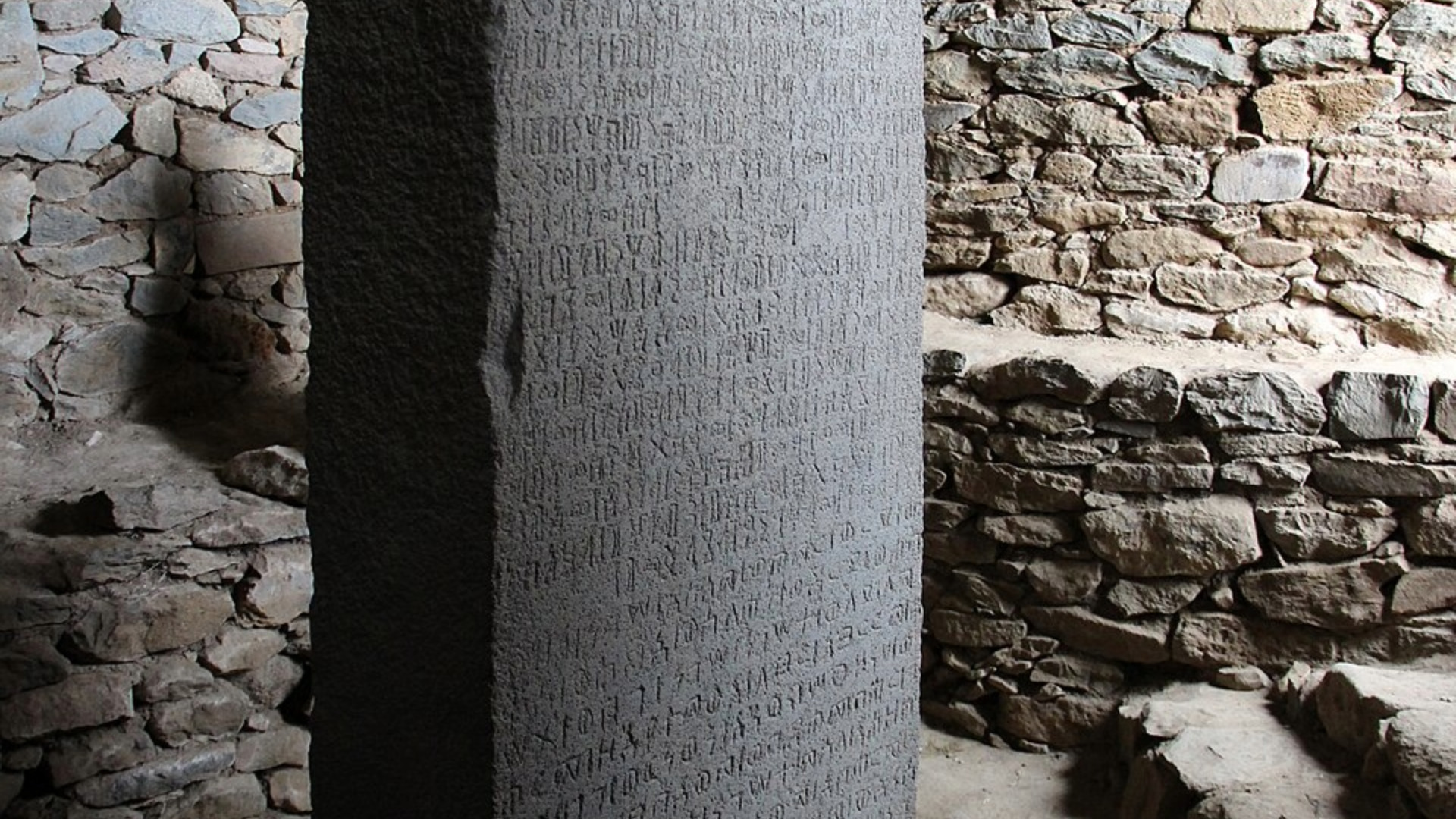
The Ezana Stone
Sailko, CC BY 3.0 , via Wikimedia Commons
Demise and succession
Ezana’s reign is usually dated c. 330–356 CE. Sources do not give a dramatic story of his death. After him, the epigraphic and coin record shows the Aksumite dynasty continued, but the exact order and dates of immediate successors are still debated. Later rulers appear on inscriptions and coins, but none match Ezana’s mix of conversion and wide inscriptional visibility.
Legacy
Ezana left two lasting marks. First, his conversion to Christianity helped shape the religious identity of the Ethiopian highlands for centuries. Second, his military and administrative actions expanded Aksum’s reach and helped shift regional power toward the Red Sea world. The Ezana Stone remains a key source for understanding his reign and late-antique politics in northeast Africa.
References
Munro Hay Stuart, Aksum: An African Civilisation of Late Antiquity
URL: https://www.routledge.com/Aksum-An-African-Civilisation-of-Late-Antiquity/Munro-Hay/p/book/9780415060001
Welsby Derek A., The Kingdom of Kush: The Napatan and Meroitic Empires
URL: https://www.britishmuseum.org/collection/term/BIOG12345
Török László, The Kingdom of Kush: Handbook of the Napatan and Meroitic Civilizations
URL: https://brill.com/view/title/1234
Phillipson David W., Foundations of an African Civilisation: Aksum and the Northern Horn 1000 BC to AD 1300
URL: https://www.jamescurrey.com/collections/african-history/products/foundations-of-an-african-civilisation
Edwards David N., The Nubian Past: An Archaeology of the Sudan
URL: https://www.routledge.com/The-Nubian-Past-An-Archaeology-of-the-Sudan/Edwards/p/book/9780415257476
Ezana Stone overview and translations
URL: https://en.wikipedia.org/wiki/Ezana_Stone
Ezana of Aksum summary
URL: https://en.wikipedia.org/wiki/Ezana_of_Aksum
Frumentius and the Christianization of Aksum
URL: https://en.wikipedia.org/wiki/Frumentius


latest video


nia via inbox
Stay connected. Subscribe and get updated on what's new with Nia!